Introduction
For years, merchant loyalty programmes have relied on fragmented mechanisms to identify customers and attribute transactions.
These mechanisms evolved in response to one core challenge:
Merchant loyalty programmes traditionally did not participate directly in the payment itself.
As a result, the industry adopted increasingly disjointed approaches such as:
- scanning loyalty cards,
- Card-Linked Offers (CLOs),
- and receipt scanning.
Each solved part of the problem.
But none fully resolved the balance between:
- scalability,
- attribution,
- reliability,
- customer experience,
- and payment flexibility.
Today, the industry is undergoing a much deeper structural transition:
From fragmented loyalty attribution models toward payment-native engagement.
This does not necessarily mean merchant programmes are becoming banks.
Rather, it means loyalty ecosystems increasingly recognise that:
- customer identity,
- transaction attribution,
- rewards,
- redemption,
- and merchant monetisation
all become significantly more powerful when embedded directly within the payment experience itself.
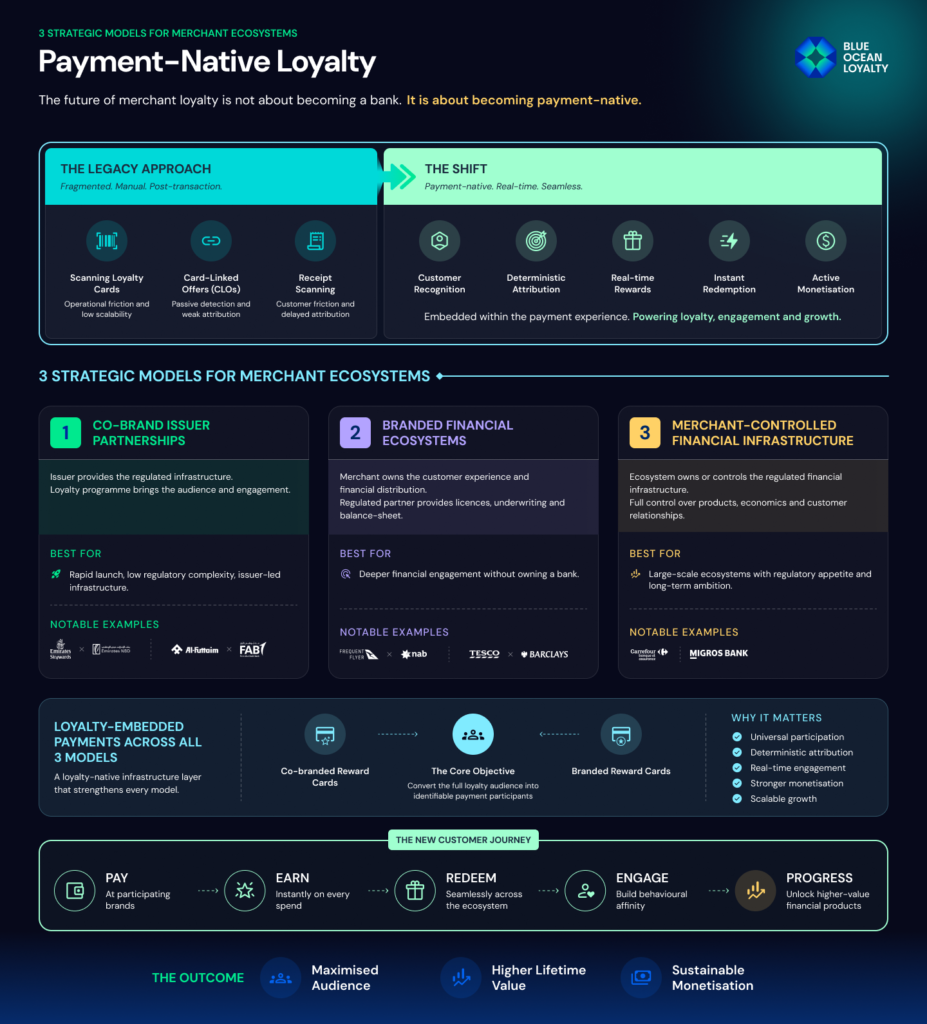
As programmes move toward payment-native engagement, merchant ecosystems broadly have three strategic models available to them — depending on their maturity, ambition, regulatory appetite, and long-term vision around monetising their audience through financial services.
The Shift Toward Payment-Native Loyalty
Historically, loyalty systems were layered onto transactions externally.
Scanning loyalty cards
required:
- PoS integrations,
- cashier participation,
- and manual customer identification.
Card-Linked Offers
removed checkout friction,
but relied on passive post-transaction detection through payment infrastructure.
Receipt scanning
enabled scalability and payment-method flexibility,
but shifted transaction identification onto the customer after purchase.
All three models fundamentally operated around the payment itself — rather than natively within it.
As a result, merchant loyalty programmes were often forced to trade off between:
- scalability,
- determinism,
- attribution,
- and customer experience.
The industry is now moving toward architectures where:
- customer recognition,
- attribution,
- rewards,
- and redemption
occur natively within the payment flow itself.
This is the structural shift toward payment-native loyalty.
The question for merchant ecosystems is therefore no longer simply:
“Should we launch a loyalty programme?
But increasingly:
How deeply should we participate in the financial layer surrounding our customer ecosystem?
In practice, three strategic models have emerged.
Model 1 — Traditional Co-Brand Issuer Partnerships
This remains the most common model globally.
In the GCC, Emirates Skywards provides a strong example through partnerships with issuers such as:
- Emirates NBD,
- Emirates Islamic,
- Dubai Islamic Bank,
- ADIB,
- and HSBC.
Under this structure:
The issuer contributes:
- regulated financial infrastructure
- payment issuance
- scheme participation
- underwriting
- transaction processing
- risk management
- reward economics
The loyalty programme contributes:
- audience access
- customer affinity
- engagement
This model became highly successful because it allowed loyalty programmes to participate in financial engagement without needing to become regulated financial institutions themselves.
However, traditional co-brand models suffer from one major limitation:
Only a relatively small subset of the loyalty audience becomes identifiable payment participants.
Typically:
- only credit-approved,
- financially engaged,
- or premium customers
become co-branded credit cardholders.
This limits:
- attributable transaction participation,
- merchant monetisation,
- and ecosystem-wide engagement.
Payment-native loyalty infrastructure fundamentally strengthens this model by:
Enabling the broader loyalty audience — not just approved credit cardholders — to become identifiable payment participants.
Rather than replacing traditional co-branded credit cards, this expands the addressable engagement funnel feeding into them.
This creates:
- a significantly larger engagement funnel,
- stronger transaction attribution,
- and progressive pathways toward cross-selling:
- co-branded credit cards,
- subscriptions,
- insurance,
- BNPL,
- lending,
- and other financial products over time.
Model 2 — Branded Financial Ecosystems
Some loyalty ecosystems seek deeper participation in financial services without directly owning banking infrastructure themselves.
This gives rise to branded financial ecosystems.
Examples include:
- Qantas Money,
- Tesco Bank partnerships,
- Sainsbury’s financial ecosystem,
- and similar white-labelled financial structures.
In these models, the merchant or loyalty ecosystem increasingly owns:
- the customer experience,
- financial product distribution,
- loyalty integration,
- engagement orchestration,
- and ecosystem positioning.
Meanwhile, regulated financial institutions continue to provide:
- banking licences,
- underwriting,
- scheme participation,
- compliance,
- and balance-sheet infrastructure.
The strategic objective shifts from:
simply rewarding transactions
toward:
Building a broader financial engagement ecosystem around the loyalty audience itself.
This enables programmes to monetise:
- financial engagement,
- payment participation,
- and customer lifetime value
far beyond traditional rewards.
Importantly, these models demonstrate that:
Merchant ecosystems do not necessarily need to become banks in order to participate deeply in financial services.
Payment-native loyalty infrastructure further strengthens this model by:
- enabling universal payment participation across the broader loyalty audience,
- increasing attributable engagement,
- and creating scalable top-of-funnel acquisition into higher-value financial products and services.
Model 3 — Merchant-Controlled Financial Infrastructure
Some ecosystems pursue even deeper financial integration by directly controlling regulated financial infrastructure itself.
Examples include:
- Carrefour Banque,
- Migros Bank,
- and historically, Bank Cler’s origins within the Coop ecosystem.
These models involve:
- licensed banking subsidiaries,
- majority-owned financial entities,
- or direct ownership stakes in regulated financial institutions.
For example:
- Carrefour Banque operates through a long-standing ownership structure between Carrefour and BNP Paribas Personal Finance.
- Migros Bank operates as a fully licensed Swiss bank directly integrated into the broader Migros retail ecosystem and loyalty infrastructure.
Under this model, the merchant ecosystem gains significantly deeper control over:
- customer financial participation,
- stored value,
- transaction infrastructure,
- payment economics,
- and financial product orchestration.
However, this also introduces:
- regulatory burden,
- operational complexity,
- compliance requirements,
- capital obligations,
- and infrastructure ownership responsibilities.
As a result, this model is typically pursued only by very large ecosystems with substantial scale and long-term strategic commitment toward financial services.
Yet even within these models, traditional financial products still often only engage a subset of the broader loyalty audience.
Payment-native loyalty infrastructure therefore remains highly valuable because it:
Enables universal attributable participation across the full audience — not just among customers who actively adopt full banking products.
Loyalty-Embedded Payments Across All Three Models
Importantly, Loyalty-Embedded Payments is not a fourth model replacing the three structures above.
Rather:
It is a loyalty-native infrastructure layer that strengthens all three.
Depending on the chosen strategic model, payment-native loyalty can be delivered through:
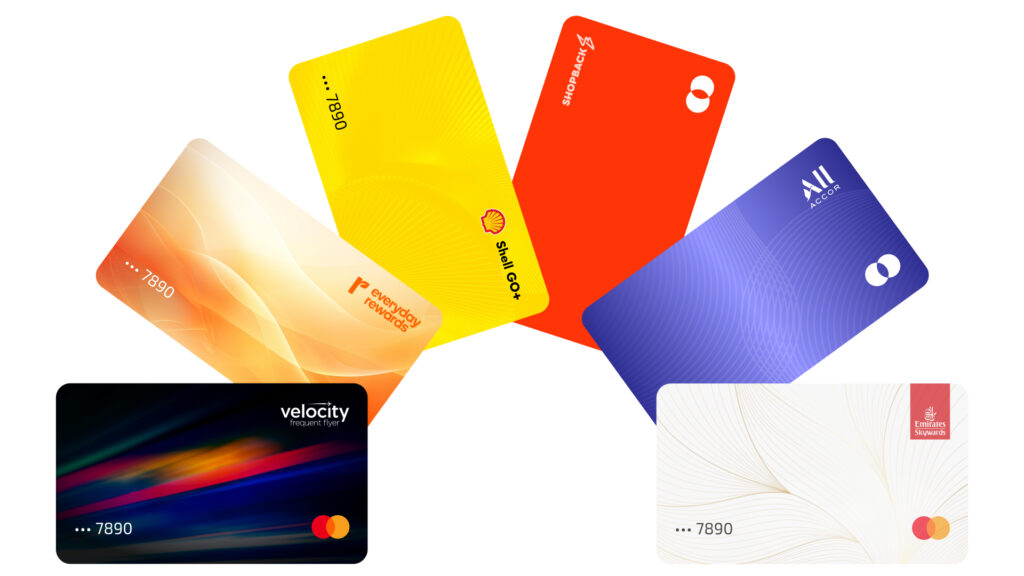
- co-branded reward cards,
- or branded reward cards.
The core objective remains the same:
Converting the full loyalty audience into identifiable payment participants, and progressively cross-selling high-value financial services.
This fundamentally changes the economics and scalability of merchant loyalty ecosystems.
Historically:
financial participation within loyalty ecosystems was limited primarily to:
- affluent users,
- approved credit cardholders,
- or customers willing to onboard into complex financial products.
Payment-native loyalty changes this dynamic entirely.
Instead of beginning with credit underwriting, the ecosystem begins with payment participation and engagement.
Consumers first:
- transact,
- earn,
- redeem,
- and develop behavioural affinity with the ecosystem.
Only then are progressively higher-value financial products introduced over time.
In effect, the loyalty ecosystem itself becomes the top-of-funnel acquisition layer for broader financial services.
This transforms loyalty ecosystems into scalable financial acquisition funnels capable of cross-selling:
- co-branded credit cards,
- subscriptions,
- insurance,
- BNPL,
- personal lending,
- auto financing,
- mortgages,
- and other financial products.
Conclusion
The future of merchant loyalty is not necessarily about becoming a bank — but about becoming natively embedded within the payment experience.
Historically, loyalty programmes relied on fragmented mechanisms layered around transactions:
- scanning loyalty cards,
- Card-Linked Offers,
- and receipt scanning.
The industry is now moving toward architectures where:
- customer recognition,
- attribution,
- rewards,
- redemption,
- and audience monetisation
are embedded directly within the payment experience itself.
How deeply a merchant ecosystem participates in the surrounding financial layer may vary:
- through co-brand issuer partnerships,
- branded financial ecosystems,
- or direct financial infrastructure ownership.
But across all three models, the strategic direction remains increasingly clear:
Payment-native engagement is becoming the foundation for the next generation of merchant loyalty ecosystems.