Introduction
Most loyalty models are typically explained through customer engagement mechanics — scanning loyalty cards, Card-Linked Offers, or receipt scanning.
But at a more fundamental level, loyalty models differ based on one simple question:
Who is the host — and what do they control?
Viewed through this lens, the market broadly divides into two structural categories:
- Issuer Loyalty
- Merchant Loyalty
The distinction matters because control over:
- the payment instrument,
- customer identification at checkout,
- transaction visibility,
- and reward economics
ultimately determines how a loyalty programme operates, scales, and monetises itself.
1. Issuer Loyalty
What issuers control
Issuer-led loyalty programmes — typically operated by banks and card issuers — naturally possess several structural advantages:
- Direct control over the payment instrument
- Native customer identification at checkout and payment
- Built-in transaction visibility
- Native reward economics funded through interchange revenue
This is why issuer-led rewards programmes historically became the earliest form of payment-native loyalty.
The reward mechanism is already embedded within the payment relationship itself.
Every transaction naturally generates:
- customer identity,
- transaction data,
- and interchange revenue that funds rewards.
How issuer loyalty operates
Issuer loyalty programmes therefore typically operate through:
- interchange-funded card rewards,
- with increasingly merchant-funded offers layered on top.
Merchant-funded offers are often enabled through transaction detection infrastructure such as Card-Linked Offers (CLOs).
In this model:
- customer identification,
- payment participation,
- and transaction visibility
are already solved.
The issuer’s challenge is therefore not identifying the customer or detecting the transaction.
Instead, the core challenge becomes:
Proving incrementality and attribution for merchant-funded offers.
In other words:
Did the offer genuinely influence spend — or would the transaction have occurred anyway?
2. Merchant Loyalty
Merchant loyalty includes:
- retailers,
- airline loyalty programmes,
- coalition loyalty ecosystems,
- cashback platforms,
- and broader lifestyle rewards programmes.
Unlike issuers, merchant and coalition programmes typically possess:
- strong customer relationships,
- engaged audiences,
- direct control over offers,
- and merchandising economics.
However, structurally, they lack:
- native control over the payment instrument,
- deterministic customer identification at checkout,
- and direct transaction visibility.
This creates a fundamentally different set of challenges.
How Merchant Loyalty Evolved
Because merchant loyalty programmes sit outside the payment itself, the industry evolved through two parallel categories of mechanisms:
- Customer Identification & Transaction Participation
- Audience Monetisation
A. Customer Identification & Transaction Participation
These models focused primarily on:
- customer identification,
- transaction attribution,
- and reward participation
within:
- the merchant’s own stores,
- or participating partner ecosystems.
Scanning Loyalty Cards
The earliest approach relied on customers identifying themselves at checkout through:
- loyalty cards,
- apps,
- or phone numbers.
This provided:
- strong attribution,
- reliable customer identification,
- and payment method flexibility.
But it also introduced:
- PoS integrations,
- staff dependency,
- operational friction,
- and scalability limitations.
(We explored these structural trade-offs in more detail in our earlier article: Why Scanning Loyalty Cards Is Holding Retail Back)
Card-Linked Offers (CLOs)
Card-Linked Offers attempted to remove checkout friction entirely.
Rather than identifying customers before payment, transactions were detected afterwards through payment infrastructure.
This solved:
- operational scalability,
- and checkout friction.
But introduced:
- weaker attribution,
- passive engagement,
- inconsistent transaction visibility,
- and dependence on enrolled payment instruments.
(For a deeper analysis of CLO infrastructure and attribution limitations, see: Why Card-Linked Offers Fall Short of True Loyalty and Not All Card-Linked Offers Are Built the Same)
Receipt Scanning
Receipt scanning emerged as another workaround model.
Rather than integrating into:
- checkout infrastructure,
or - payment infrastructure,
the customer simply uploads proof of purchase after the transaction.
This enables:
- scalability across fragmented merchant ecosystems,
- payment-method agnosticism,
- and SKU-level basket visibility.
But it also shifts transaction identification responsibility onto the customer.
Most importantly:
Receipt scanning provides proof of purchase — not necessarily proof of attribution.
(We explored this distinction further in: Receipt Scanning: Proof of Purchase ≠ Proof of Attribution)
B. Audience Monetisation
Merchant and coalition programmes also sought ways to monetise their audience itself — not just within participating merchant ecosystems, but against:
- issuing banks,
- payment schemes,
- and broader consumer spend.
Traditional Co-Branded Credit Cards
Co-branded credit cards emerged as the primary mechanism for this.
They enabled merchant and coalition programmes to:
- monetise customer affinity,
- participate indirectly in interchange economics,
- and extend engagement beyond their own merchant footprint.
However, traditional co-branded credit cards remained structurally limited because:
- only a small subset of members qualified,
- issuers retained primary ownership of the payment relationship,
- and the programme itself still lacked native ownership of the broader payment infrastructure.
In many ways, traditional co-branded credit cards represented an attempt by merchant loyalty programmes to partially bridge the structural advantages naturally held by issuers.
(We explored the structural trade-off between premium engagement and scalable participation in more detail in our earlier article: Why Legacy Loyalty Models Can’t Scale — and What Replaces Them)
The Structural Divide
Viewed from first principles, the loyalty landscape ultimately divides into two structural categories:
Issuer Loyalty
Programmes that natively control:
- the payment instrument,
- customer identification at checkout,
- transaction visibility,
- and reward economics through interchange revenue.
This structural advantage is why issuer-led loyalty programmes have historically delivered:
- seamless experiences,
- deterministic attribution,
- and scalable transaction-linked rewards.
Merchant Loyalty
Programmes that control:
- customer relationships,
- offers,
- and audience engagement,
but lack:
- native payment infrastructure,
- deterministic customer identification at checkout,
- and embedded transaction visibility.
As a result, merchant and coalition programmes have historically relied on:
- transaction identification mechanisms such as scanning loyalty cards, CLOs, and receipt scanning,
- alongside audience monetisation models such as traditional co-branded credit cards.
All fundamentally attempting to bridge the structural advantages naturally held by issuers.
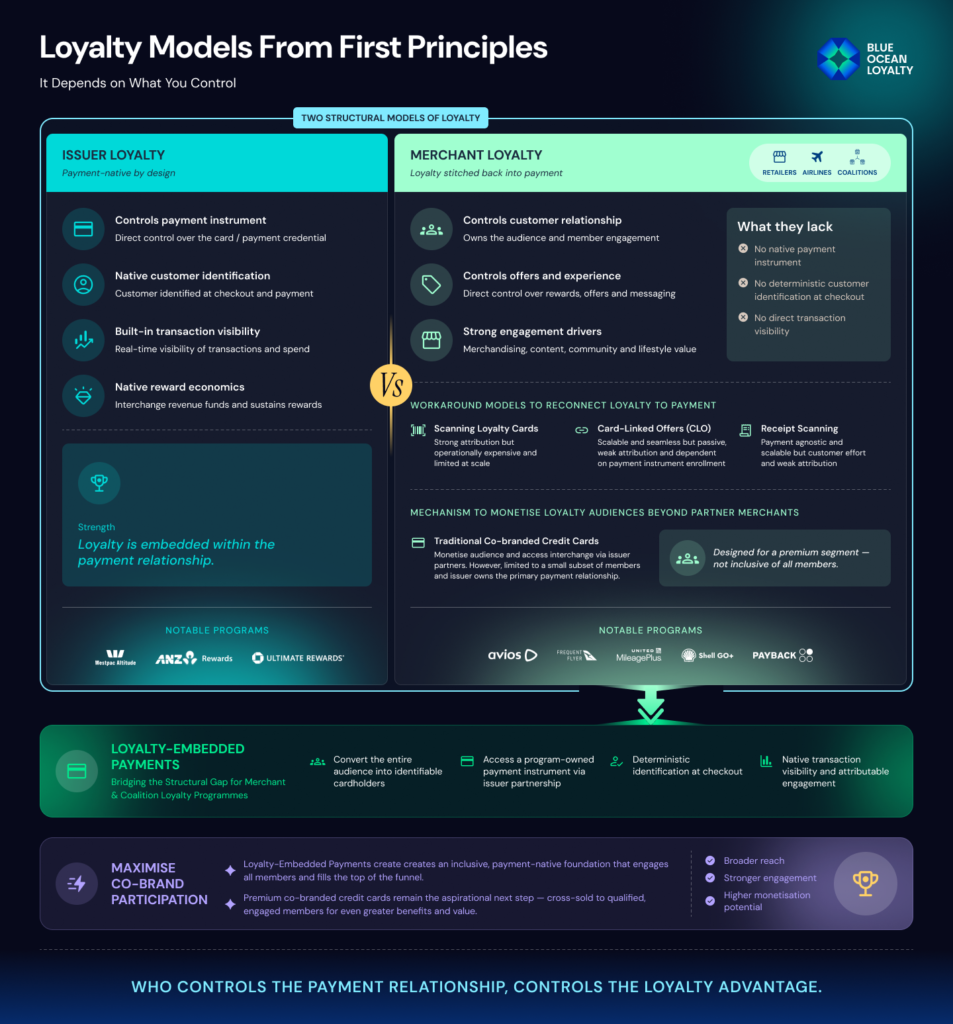
The structural differences between issuer and merchant loyalty models can be visualised as follows:
Bridging the Structural Gap
This naturally raises a broader question:
What would it take for merchant and coalition loyalty programmes to operate with issuer-like infrastructure advantages?
In practical terms, this would mean enabling programmes to:
- convert their audience into identifiable cardholders,
- access a programme-linked payment instrument,
- recognise customers deterministically at checkout,
- and gain native transaction visibility.
This is the fundamental idea behind Loyalty-Embedded Payments.
Not by requiring brands to become licensed issuers themselves and absorb the associated regulatory complexity — but by enabling them to partner with co-brand issuers while retaining ownership of the loyalty relationship and customer engagement layer.
Conclusion
The evolution of loyalty infrastructure has largely been shaped by one underlying structural reality:
Whoever controls the payment relationship holds the strongest position in loyalty.
Issuer loyalty programmes historically held that advantage because they naturally controlled:
- the payment credential,
- customer identification,
- transaction visibility,
- and reward economics.
Merchant and coalition programmes, meanwhile, were forced to rely on expensive, fragmented, and often sub-optimal mechanisms to reconnect loyalty back into the payment itself.
From:
- scanning loyalty cards,
- to Card-Linked Offers,
- to receipt scanning,
the industry has effectively been attempting to compensate for the same structural limitation:
The lack of native payment infrastructure and deterministic customer identification at checkout.
Loyalty-Embedded Payments represent the next step in that evolution.
Not by replacing traditional co-branded credit cards — but by expanding the model itself.
Rather than limiting payment-native loyalty participation to a small subset of premium cardholders, Loyalty-Embedded Payments enable programmes to:
- convert their broader audience into identifiable co-branded reward cardholders,
- establish deterministic transaction participation at scale,
- and create a significantly larger engagement and monetisation funnel.
Once this payment-native baseline is established, programmes can begin extending beyond loyalty itself.
In this model, traditional premium co-branded credit cards continue to play an important role — but increasingly as aspirational, high-value propositions cross-sold to engaged and qualified members already actively participating within the programme ecosystem.
The same infrastructure can be used to:
- issue digital gift cards,
- enable foreign remittance,
- and distribute broader financial products such as BNPL, personal loans, auto loans, mortgages, and insurance.
In effect, the programme begins engaging, rewarding, and monetising its audience from both sides:
- against merchants through merchant-funded offers,
- and against co-brand issuers through financial products and services delivered directly within the brand experience.
This represents an important shift from traditional co-brand models, where programmes primarily handed members off to issuers for downstream cross-selling.
Instead, the loyalty programme itself increasingly becomes the engagement and distribution layer — while still leveraging the issuer for:
- regulated financial infrastructure,
- banking products,
- compliance,
- and balance sheet capabilities.
In this sense, Loyalty-Embedded Payments are not simply evolving loyalty infrastructure.
They are creating a new model where:
Loyalty, payments, merchant-funded incentives, and financial services distribution converge into a single payment-native ecosystem.